Engineering
Hardware projects from Durham University: an open-day greeter for a Unitree G1 humanoid, an autonomous forklift, a wireless-powered artificial heart, a repeatable autonomous vehicle, and training in high-performance computing.
Open Day greeter robot
Software for a Unitree G1 humanoid at a Durham University open day: it notices visitors, invites them over by naming something they wear, and chats with them through a realtime voice model.
- Perception
- A chest-mounted USB webcam feeds YOLO26n-pose with BoT-SORT tracking, run with TensorRT on the robot's Jetson Orin NX. Distance, facing, speed and group cues decide when to invite someone; by default anyone who looks interested, or only people wearing green. The robot's own head depth camera checks whether someone is standing on the talk spot.
- Conversation
- The OpenAI Realtime API (gpt-realtime-2.1) through the robot's microphone and speaker. The opening line is generated while a visitor approaches, and each visitor turn carries a fresh camera frame.
- Safety
- The program never moves the robot: there are no arm, waist or walking commands. It only talks, listens, looks and drives the LED strip, and it refers to clothing and objects, never to appearance.
- Deployment
- One process on the Jetson, installed over SSH and online through a pocket 4G/5G router. A 3D-printed chest bracket and head-top arch hold the camera.
- Status
- v0.7 (November 2026): 170 tests pass on a laptop; not yet run on the robot. The head arch is checked against Unitree's official model but not printed yet.
Interactive Open Day sceneCamera mounts in 3DOpen Day animationCode on GitHubResearch profile
Automated Material Mover
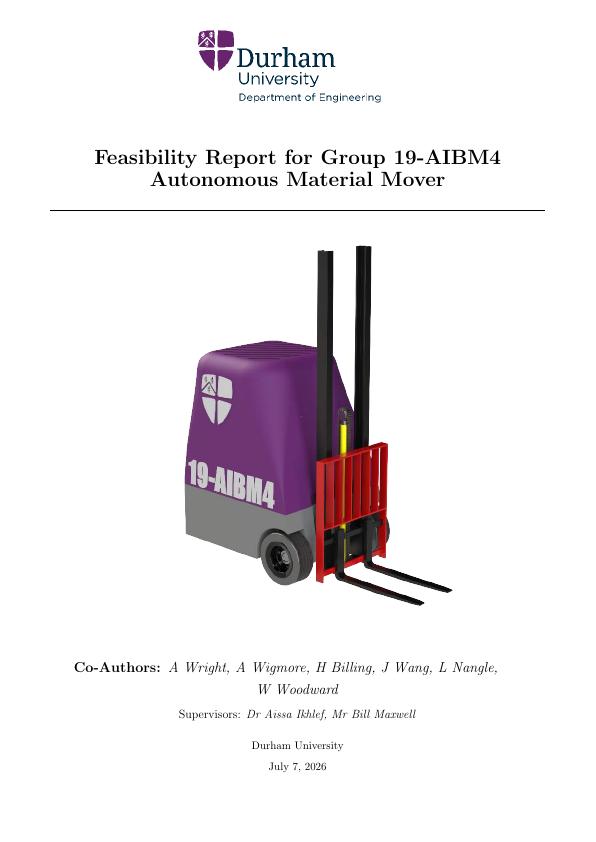
Co-designed and prototyped an automated guided vehicle that moves materials around a factory without a driver, and tested whether it is technically and financially feasible.
- Mechanism
- Three wheels with differential steering around a central axle, chosen for manoeuvrability in factory aisles.
- Navigation
- Tape-guided sensing for precise, repeatable paths.
- Validation
- Structural calculations, cost evaluation against manual forklifts, and a risk assessment, with the design checked against ISO 3691-4 for driverless industrial trucks.
- Sustainability
- Recyclable steel body and forks, and airless tyres for durability.
What this shows
Three wheels, one guide tape
Three-wheel AGV with differential steering, following a guide tape (dashed).
Schematic.
Durham Total Artificial Heart
Wireless power and control electronics for an artificial heart: an interdisciplinary medical-engineering project that turned clinical needs for cardiovascular support into implementable engineering requirements.
- Defined system requirements and partitioned the wireless powering solution into subsystems.
- Coordinated development of high-efficiency power-transfer circuits, custom motors designed in ANSYS, and the control electronics.
What this shows
Wireless power for an artificial heart
Artificial heart with a wireless power link; the dashed ring marks the transfer coil.
Schematic.
IMechE Repeatable Vehicle Challenge
Engineered, fabricated, calibrated and repeatedly tested an autonomous vehicle that travels a set distance, interacts with a target and returns to a repeatable stopping position, with no external control.
What this shows
Out, interact, return
The vehicle runs a set distance, interacts with a target and returns to a repeatable stop.
Schematic.
High-performance computing
HPC Summer School: intensive training in HPC systems and architectures, including parallel programming with OpenMP and MPI and GPU acceleration, then applied to engineering problems in parallel computing, large-scale data processing and scientific computing.
What this shows
Message passing between nodes
Four compute nodes exchanging data, as in MPI.
Schematic.