Engineering

Hardware projects from Durham University: an autonomous forklift, a wireless-powered artificial heart, a repeatable autonomous vehicle, and training in high-performance computing.

Automated Material Mover

2024–2025. Group 19-AIBM4. Supervisors: Dr Aissa Ikhlef, Mr Bill Maxwell.

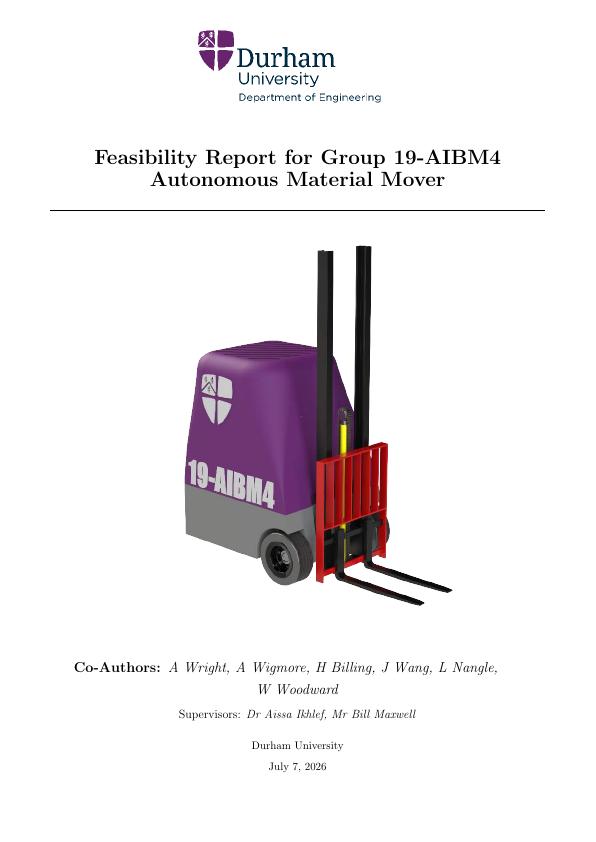
First page of the Automated Material Mover feasibility report

A three-wheeled autonomous forklift for factory material handling

Co-designed and prototyped an automated guided vehicle that moves materials around a factory without a driver, and tested whether it is technically and financially feasible.

  • Mechanism. Three wheels with differential steering around a central axle, chosen for manoeuvrability in factory aisles.
  • Navigation. Tape-guided sensing for precise, repeatable paths.
  • Validation. Structural calculations, cost evaluation against manual forklifts, and a risk assessment, with the design checked against ISO 3691-4 for driverless industrial trucks.
  • Sustainability. Recyclable steel body and forks, and airless tyres for durability.

Durham Total Artificial Heart

2024–2025. Supervisor: Prof. Ashraf W. Khir.

Wireless power and control electronics for an artificial heart

An interdisciplinary medical-engineering project that turned clinical needs for cardiovascular support into implementable engineering requirements.

  • Defined system requirements and partitioned the wireless powering solution into subsystems.
  • Coordinated development of high-efficiency power-transfer circuits, custom motors designed in ANSYS, and the control electronics.

Tools LTspice, KiCad, ANSYS

IMechE Repeatable Vehicle Challenge

2023–2024.

A self-contained vehicle that does the same task every time

Engineered, fabricated, calibrated and repeatedly tested an autonomous vehicle that travels a set distance, interacts with a target and returns to a repeatable stopping position, with no external control.

High-performance computing

Jun–Jul 2024. EPCC, University of Edinburgh.

HPC Summer School

Intensive training in HPC systems and architectures, including parallel programming with OpenMP and MPI and GPU acceleration, then applied to engineering problems in parallel computing, large-scale data processing and scientific computing.

Immersive version 中文