Research
Robots that act in deformable, partially observed environments: vision–language–action and world-action models for endoscopy, a humanoid robot that starts conversations at the university open day, and learning from small medical datasets.
Interests: embodied AI, vision–language–action systems, cross-embodiment learning, autonomous surgical robotics, transfer learning under limited data, human–computer interaction.
EndoWAM: A Grounded World-Action Model for Generalizable Endoscopic Navigation
Learned endoscopy policies usually act on the current frame alone, which makes them fragile under tissue deformation, occlusion and fast viewpoint change. EndoWAM is the first world-action model for generalisable robotic endoscopic navigation. It introduces future grounding: a lightweight diffusion transformer predicts task-relevant target regions in future frames from the intermediate denoising features of a video world model, and a discrete action expert shares that predictive representation, so control runs in real time from a single denoising pass. The paper also introduces EndoMotion, a robotic endoscopy dataset spanning ureteroscopy, oesophagoscopy and ERCP. EndoWAM outperforms all baselines and alternative grounding strategies and generalises zero-shot to unseen viewpoints, environments and targets.
Interactive Open Day robot
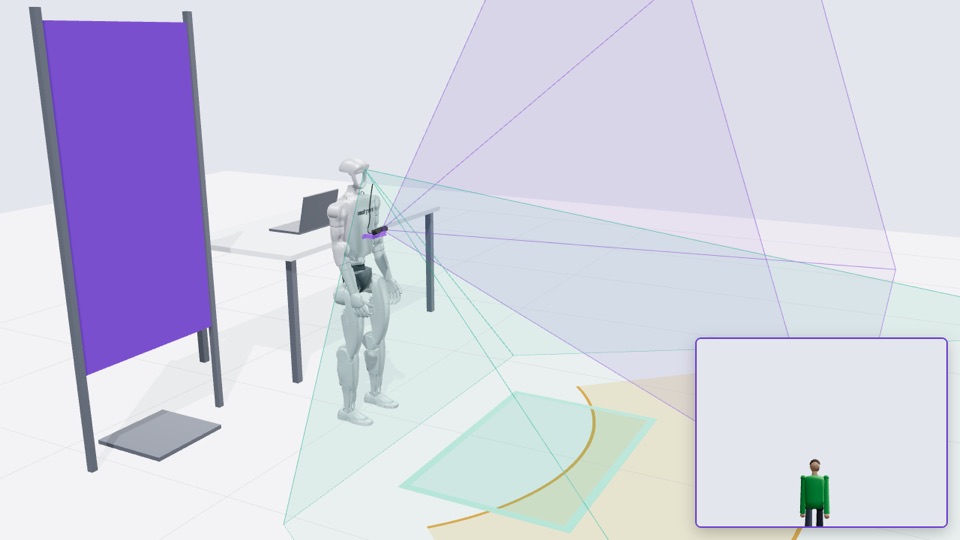
A Unitree G1 humanoid that starts conversations at the Durham University open day. It notices visitors, decides when to speak, invites them over by naming something they wear, and chats with them, using what its camera sees.
- Separates when to speak from what to say: on-robot person tracking (YOLO26n-pose with BoT-SORT) reads distance, facing, speed and groups, and a realtime speech model with vision (OpenAI gpt-realtime-2.1) writes the opening line and holds the conversation.
- Grounded in a literature review of small vision–language models, realtime speech models, streaming video models that decide when to respond, and studies of how robots should start interactions in public spaces.
- The program runs as one process on the robot's Jetson Orin NX and reaches the speech model online through a pocket 4G/5G router. It never moves the robot, and it refers only to clothing and objects, never to appearance.
- Version 0.7 (November 2026): 170 tests pass on a laptop; not yet run on the robot.
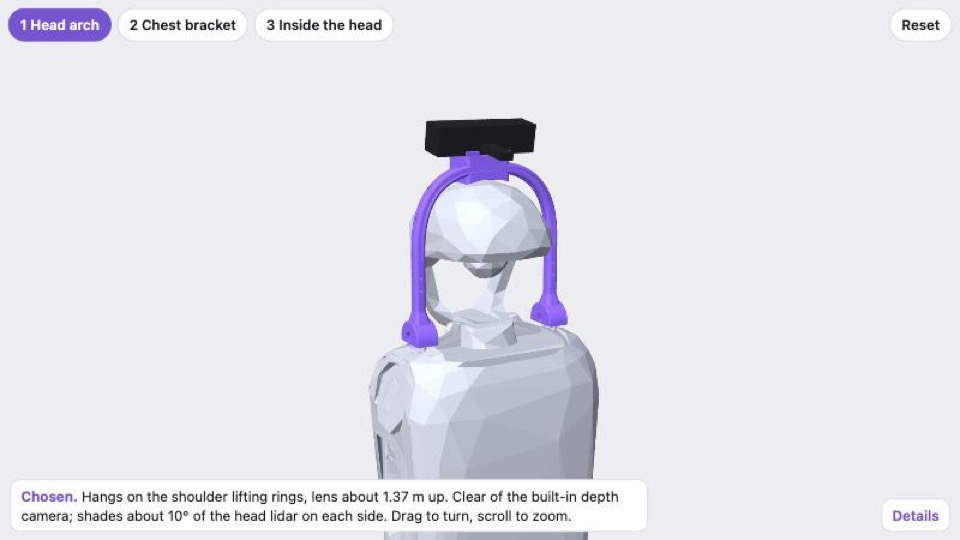
Interactive Open Day sceneCamera mounts in 3DFull-screen animationCode on GitHubResearch profileEngineering details
Small data, large models: transfer learning for medical image classification
Clinical datasets are small. This project measures how well a retinal foundation model detects glaucoma from colour fundus photographs when only a few hundred labelled images exist, and whether the result holds on new cameras and datasets.
RETFound-Green, a compute-efficient retinal foundation model, turns each image into 384 features. Simple classifiers are trained on these frozen features first; partial fine-tuning of the encoder follows.
- Data
- Chákṣu: 1,345 images from three cameras, each graded by five experts (glaucoma by majority); PAPILA for external validation. Splits are grouped by eye or patient, after a check found that RETFound's released PAPILA split puts the two eyes of 121 of 244 patients on different sides.
- Method
- Logistic regression, SVM, k-nearest neighbours and an MLP, tuned with Optuna by 5-fold cross-validation on 1,141 images; a rule fixed in advance picks the simplest model tied with the best, and the held-out test set is used once.
- Results so far
- Logistic regression on frozen features: test AUROC 0.872 (95% CI 0.810–0.923) on 204 held-out images; at a threshold set for 90% sensitivity it found all 28 glaucoma images, at a specificity of 0.51. Regularising the MLP reduced its overfitting but did not raise AUROC, which points to the frozen representation or the labels as the limit.
- Next
- Partial fine-tuning of the encoder; transfer to PAPILA and to a camera left out of training, including whether the decision threshold transfers; and how expert agreement and training-set size limit performance.
Outputs: code, data splits and results are public on GitHub; a fine-tuning comparison, an external-validation table and a data-efficiency figure follow.
What this shows
Retina under scarce labels
A retinal fundus with its optic disc and vessel tree. The dots fill in the training-set sizes of the planned data-efficiency curve (25, 50, 100 and 200 images); the three rings stand for Chákṣu's three cameras, each left out of training in turn.
Use the step buttons or scroll to change the training-set size.Tap a step.
Schematic, not results; the first results are in the text.
BiliVLA: scene-aware VLA for autonomous ERCP navigation
A vision–language–action system for navigating the bile duct during ERCP, where the scene deforms and the target is easy to lose.
96.25%
91.96%
84.85%
- Supported a two-stage pipeline: grounding-enhanced supervised fine-tuning followed by GRPO reinforcement optimisation, with scene-aware grounding and safety-aware recovery.
- Integrated the hardware, multimodal trajectories and 3-DoF actions used for closed-loop control in phantom experiments.
What this shows
Grounding in the bile duct
A bile-duct lumen in an ERCP phantom. The bracket is a grounding box on the duct opening and the dotted line is the planned path.
Move the pointer to shift the scene; the box keeps the opening.Drag the scene.
Schematic, not BiliVLA output.
Teleoperated flexible endoscopy benchmark
A reproducible multimodal benchmark for learning endoscope navigation from teleoperation.
150
Synchronised video and robot-state segments
224 × 224
Image–action trajectory frames
π0.5
VLA navigation baseline
- Collected 150 synchronised endoscopic video and robot-state segments, and resolved timestamp alignment across video, high-frequency robot states and PDT hardware parameters.
- Built the cleaning, frame-extraction, YOLO region-of-interest cropping and image–action trajectory workflows.
- Deployed the open-source π0.5 policy as a VLA navigation baseline.
What this shows
150 synchronised segments
One tile per synchronised endoscopic video and robot-state segment in the benchmark; frames are cropped to 224 × 224 for the image–action trajectories.
Hover a tile to read its index.Tap a tile.
Schematic of the dataset size, not the data itself.
Trileg-ESD: vision-guided magnetic soft robot
A miniature three-legged magnetic soft robot that assists tissue manipulation during endoscopic submucosal dissection, with a cooperative VLA algorithm for two soft robots.
- Structured controllable motion around primitives: squatting, leg lifting, rotation, crawling and stance recovery.
- Investigated a vision–language controller that maps current and recent endoscopic frames plus a motion instruction to voltage commands for three electromagnetic coils.
What this shows
Three coils, one soft robot
Three electromagnetic coils set 120° apart drive a three-legged magnetic soft robot; the dashed field lines show which coil is active.
Drag the robot; the nearest coil takes over.Drag the robot.
Schematic, not a field simulation.
Markerless motion-to-sound interaction
Gesture-controlled music generation from markerless, AI-assisted motion capture.
- Built and evaluated a low-latency Python workflow using Google MediaPipe that maps body movement to sound.
- Contributed to experimental design, coding, analysis and reporting across engineering, neuroscience, psychology and human–computer interaction.
What this shows
Movement into sound
Body landmarks of the kind MediaPipe tracks; arm movement drives a waveform, as in the markerless motion-to-sound pipeline.
Move the pointer to raise the arm; faster movement, larger wave.Drag across the figure.
Visual only, no audio.