A video world model predicts where the task-relevant target region will appear in future frames (t + k), marked by the green bracket. An action expert plans the endoscope's navigation actions from the current frame (t) toward it, drawn as the cyan path.
Future target region at t + k
Predicted actions from the frame at t
Drag the bracket or click the lumen to move the target · Hold to advance · Arrow keys work tooDrag the bracket to move the target · Press and hold to advance
A stylised schematic, not real footage or model output.
Click (i) to explain · Drag the target · Hold to advanceTap (i) to explain · Drag the target · Press and hold
I study how robots can see, reason and act in places that are hard to model, such as the inside of the body, using vision–language–action and world-action models.
At Durham, under the supervision of Dr Amir Atapour-Abarghouei and Dr Chris Chen, I am developing software that lets a Unitree G1 humanoid start conversations with visitors at the university open day. Before that I worked in Prof. Hongliang Ren's Medical Robotics Group at CUHK on autonomous endoscopic navigation.
A video world model predicts where task-relevant target regions will appear in future frames, and a lightweight action expert shares that predictive representation to choose navigation actions in a single denoising pass. Trained on EndoMotion, a robotic endoscopy dataset spanning ureteroscopy, oesophagoscopy and ERCP, it generalises zero-shot to unseen viewpoints, environments and targets.
Scrolling moves time from the current frame t to t + k. The bracket marks where the target region is predicted to appear at each step; the path is the action plan computed from frame t.
Scroll, or jump with the t · t + k/2 · t + k buttons.Use the t · t + k/2 · t + k buttons.
A stylised schematic, not real footage or model output.
Research · 06
Research projects
01
01 · Durham University, ongoing
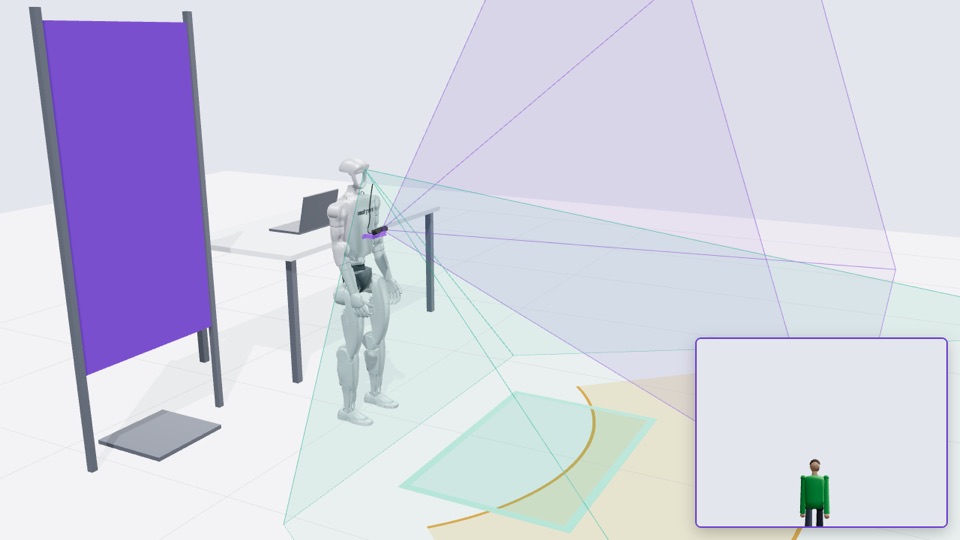
Interactive Open Day robot
A Unitree G1 humanoid that notices open-day visitors, invites them over by naming something they wear and chats with them, using what its camera sees, under the supervision of Dr Amir Atapour-Abarghouei and Dr Chris Chen.
Glaucoma detection from fundus photographs with frozen features from the retinal foundation model RETFound-Green. On Chákṣu, a classifier chosen by 5-fold cross-validation reached a held-out test AUROC of 0.872; partial fine-tuning and transfer to new cameras and datasets come next. Under the supervision of Dr Raheleh Kafieh.
A retinal fundus with its optic disc and vessel tree. The dots fill in the training-set sizes of the planned data-efficiency curve (25, 50, 100 and 200 images); the three rings stand for Chákṣu's three cameras, each left out of training in turn.
Use the step buttons or scroll to change the training-set size.Tap a step.
Schematic, not results; the first results are in the text.
03
03 · CUHK Medical Robotics Group, 2026
BiliVLA: scene-aware VLA for autonomous ERCP navigation
Vision–language–action navigation of the bile duct, reported in ERCP phantom experiments.
One tile per synchronised endoscopic video and robot-state segment in the benchmark; frames are cropped to 224 × 224 for the image–action trajectories.
Hover a tile to read its index.Tap a tile.
Schematic of the dataset size, not the data itself.
05
05 · CUHK Medical Robotics Group, 2026
Trileg-ESD: vision-guided magnetic soft robot
A three-legged magnetic soft robot for tissue manipulation, driven by a vision–language controller over three electromagnetic coils.